

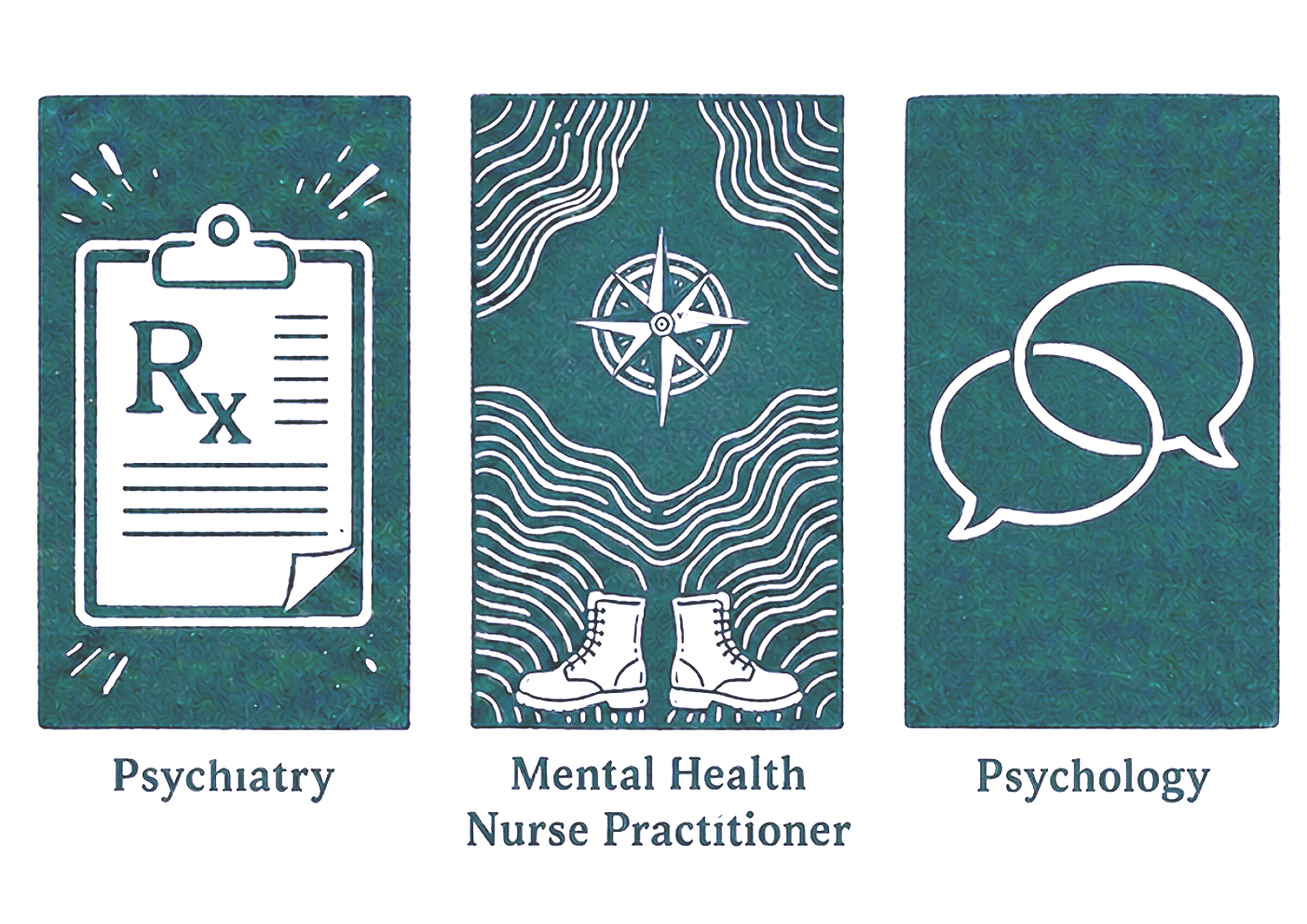
Which one do I need? What is the difference between Psychiatrist - Psychologist - Mental Health Nurse Practitoner?
Mental Health Nurse Practitioner
•The Bridge, Not the Divide: Traditional mental health care often fragments your journey: a psychologist for therapy, a psychiatrist for medication. This means repeating your story, coordinating appointments, and often feeling like no one person holds the whole picture.
As a Mental Health Nurse Practitioner (MHNP)—referred to internationally or in US models as a Psychiatric Mental Health Nurse Practitioner (PMHNP)—my care bridges the gap between this divide. I provide both psychotherapy and medication management, ensuring your care is unified, consistent, and deeply personal.
•Holistic & Trauma-Proficient: Our nursing background instills a holistic perspective, viewing you as a whole person within your unique life context.
This means understanding how your biology, lived experience, and environment converge, especially when navigating complex trauma, neurodivergence, or chronic stress. We don't just treat symptoms; we work with you to tend to your entire internal emotional landscape.
At Mindscaper this means full prescribing authority to manage medications alongside advanced training in deep trauma therapies like EMDR and Internal Family Systems.
Care is structured around private billing and direct access to Medicare rebates without a GP Mental Health Care Plan. Choosing a Mental Health Nurse Practitioner means choosing comprehensive, integrated care from a seasoned professional who is uniquely positioned to hold your entire mental health journey with expertise and compassion.
What can a Mental Health Nurse Practitioner do?
Comprehensive mental health assessment and diagnosis
Prescribe and manage psychotropic medications
Request pathology and investigations
Provide psychotherapy across evidence-based modalities
Coordinate and refer across the care team
Write clinical letters and reports
Psychiatrist
Psychiatrists are medical doctors who undergo extensive post-graduate specialist training to manage complex biomedical, diagnostic, and psychopharmacological interventions.
They are the essential anchor for severe clinical pathology, formal diagnostic assessments, and overarching medical oversight.
Because of their highly specialised consultative role, their practice model is often structured around targeted psychiatric evaluations and medication optimisation rather than intensive, weekly psychotherapeutic containers
Psychologist
Psychologists are allied health professionals experts in human behaviour, psychometric testing, and the delivery of evidence-based talk therapies.
They provide vital, structured support for a wide range of mental health conditions.
Within the Australian healthcare framework, their care is frequently aligned with the Medicare Better Access initiative, via a GP Mental Health Treatment Plan which provides a valuable, capped number of subsidised sessions per calendar year to address specific psychological goals
Psychologists do not prescribe medication.